
Crane & Rigging Industry Insights

Current Articles | RSS Feed RSS Feed

Cortland Sets a Record: World’s Largest 12 Strand Rope


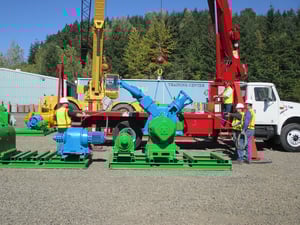
cortland ropeCortland, Anacortes, Washington, recently produced the world’s largest 12-strand rope for a European client, constructed on the giant 12 strand braiding machine using Cortland’s patented Plasma® synthetic fibre. This rope will be used to create an enormous industrial lifting sling.

This unique rope was created from more than 52,000 individual Plasma® strands using Cortland’s patented 12×12® braiding technique. This exclusive braiding process combines individual 12-braided ropes into a finished 12-strand rope of exceptional strength and flexibility. The finished size of this particular rope is 176mm with a minimum tensile strength of 1845MT (Metric Tonnes).

Despite the exceptional size, this rope is 7 to 8 times lighter than a comparable steel rope, yet is much easier to handle and splice. The rope will be used in a grommet configuration with an MBL exceeding 3044MT for heavy lift operations.

Cortland provides worldwide experience in creating lightweight rope, slings, cables and umbilicals to the oil and gas, heavy marine, subsea, ROV, seismic, defense and medical markets. Cortland is part of Actuant Corporation (NYSE: ATU), a diversified industrial company with operations in more than 30 countries. For more information, go to www.cortlandcompany.com.

Tags: ,

Newly Re-Engineered Socketing Resin “Socket Lock” - The Wire


socket lockSea-Fit, Inc., is pleased to announce that it has just completed an extensive effort to improve and reformulate its socketing resin product, Socket Lock. This has been a joint effort with ITW Polymer Technologies and the process has taken nearly 18 months to complete. The new product has improved grip performance and has undergone static, dynamic and shock load testing. In addition, improvements were made to the formulation to increase the product’s stability and toughness.

To complement the enhancements to the product’s performance capabilities, the resin and hardener are now innovatively packaged in environmentally sealed foil packs. To further ensure stability, the components are then placed in plastic containers fitted with vapor lock lids. The plastic container can be used as the mixing vessel and is obviously well suited for corrosive marine environments. Not only is this packaging easy to use, it serves to ensure the product’s freshness.

To make mixing easier, the resin color is now bright green and the hardener is white and in a soft paste form. When mixing, it is easy to see when the mixture is fully blended as the white swirls will disappear when fully mixed. All components are designed to be free of dusty, hazardous components. To make pouring sockets a cleaner process, each kit is now supplied with a unique disposable pouring funnel. Printed on the funnel is useful information such as socket volumes and recommended socketing practices.

Socket Lock has met or exceeded all of the performance and properties criteria to be Type Approved by both DNV and ABS.

Product information is available on-line at www.socket-lock.com.

This article was originally published by The Wire - Newly Re-Engineered Socketing Resin “Socket Lock”.

Barnhart Crane & Rigging Purchases Powell’s Crane Rental Division


US rental firm Barnhart Crane & Rigging has agreed to purchase the crane rental division of Powell Companies.

James Powell established the Powell Companies more than 40 years ago, in 1969, around two core segments-crane rental and steel erection-with new units later added to the business including horizontal centrifuge manufacturer Decanter, a coal and minerals processing engineering and construction division, and an IT business, Powell Technologies.

Under the current deal, the crane rental business will transfer to Barnhart, while Powell retains the remaining businesses.

Powell's crane fleet includes boom trucks up to 28USt capacity, all terrains from 22-300USt, and conventional truck cranes with capacities of up to 150USt, working from depots in Knoxville and Johnson City, Tennessee. Prior to the deal, Barnhart had 23 branches across the US, including locations in Knoxville and Kingsport, Tennessee. Barnhart's crane fleet includes heavy lift cranes with capacities up to 1,760USt, mobile cranes, rigging systems, and special transport equipment.

Barnhart CEO Alan Barnhart said, "We feel like this is a win/win for everyone involved. This agreement will give our current customers access to a larger equipment inventory. As for the former customers of Powell's Crane Division, we are going to work hard to build a relationship with them and earn their business. In the end we think they will be very pleased with the multitude of new services and equipment we can provide."

This article was originally published by The WIRE here on June 7, 2010.

Containment Domes for BP Oil Spill - The WIRE


PORT FOURCHON, La. - What British Petroleum calls the best short-term solution to stopping the gush of oil, still leaking out of control into the Gulf of Mexico, was expected to leave Port Fourchon late this afternoon.

Crews loaded the 100-ton, 40-feet high steel and concrete box on to a supply boat. BP is hauling it 50 miles offshore in the hopes of bottling up the oil, now spewing more than 200,000 gallons of crude oil a day.

Tuesday, underwater robotic subs capped one of three leaks.

Chemical dispersants are also being sprayed on the wellhead to break up oil before it hits the surface.

BP is hoping to drop the oil containment system on top of one of the two remaining leaks.

"It will actually seal over the leak and then we'll engineer piping that goes up to a barge and we'll be able to funnel that oil that is escaping now," said BP spokesman Curtis Thomas.

BP hopes to guide the containment boxes down to the underwater leak with remote submarines.

New Orleans engineer Sam Scandaliato said working in 5000 feet of water will be difficult. "I think the trick is getting over that hole," said Scandaliato. "That's like looking for a needle in a haystack. Although they know where the needle is, they got to get it through this mile of water."

Scandaliato also said if the box hits the hole, getting a good seal on the sandy seabed could be the system's Achilles' heel.

"This is really an experiment," said Scandaliato. "If it only works 50 percent, that's better than we got now, because I don't think we can contain this oil coming out the way it is too much longer."

This is the first time this system has been used in deep water.

BP said it will take about 12 hours to float the boxes out to the source of the leak.

"It will take about two days to put it on the sea floor," said BP chief operating officer Doug Suttles. "As you can imagine, we're landing a very, very large, essentially metal building on the sea floor to capture the flow."

BP hopes to begin the flow of oil in the containment system as early as Monday. It is only a stop gap measure until crews can drill a relief well and cap the leaks. That could take about 90 days to complete.

by Paul Murphy / Eyewitness News

This article was retrieved from The WIRE here.


Tags: , ,

OSHA Recognizes Accredited Certification of the Crane Institute of America - Columbus McKinnon Corporation


On May 5th in Washington DC, OSHA and Crane Institute of America Certification (CIC) will have a signing ceremony to highlight OSHA's formal recognition of CIC. This is only the second time OSHA has taken such a momentous action of recognition in our industry. Employers can be assured that certifications from CIC meet all OSHA regulations.

Congratulations to the Rigging Certification Committee members Mike Parnell, Chair of the RCC, and: James Cahill, Peter Cooke, Jeff Dudley, Jerry Klinke, Alex Muller, Jim Headley, Cliff Dickinson and Debbie Dickinson.

Columbus McKinnon will be offering rigging prep courses to help the industry prepare for the Rigger & Signalperson Certification and hosting CIC certification exams following the prep training. Visit www.cmcodepot.com for more information on this course.

Peter Cooke is a Corporate Trainer for CM Hoists, Columbus McKinnon Corporation in Amherst, New York.

This article was originally published on CMCO Live on May 4, 2010 here.

First US Wind Farm Approved - The WIRE


The first US offshore wind farm project won government approval on Wednesday after nearly a decade of battles involving environmentalists, Indian tribes and others.

The big Massachusetts project approved by Interior Secretary Ken Salazar is seen as a giving a major boost to wind power in the United States even though it still may face additional legal challenges.

Wind power currently account for around one percent of US electric capacity, according to the American Wind Energy Association, which said the new project is likely to provide new momentum to wind projects.

Critics have argued that the wind turbines would hurt fishing, endanger aircraft, lead to higher utility rates, and have a negative impact on tourism by marring a resource prized by many vacationers.

To minimise the impact of the project, the government has required the developer to reduce the number of turbines, reconfigure the array to diminish its visual effects and paint the turbines off-white to reduce contrast with the sea and sky yet ensure they remain visible to birds.

Cape Wind involves 130 wind turbine towers, enough to produce as much as 468 megawatts - enough power for 75 per cent of energy needs of Cape Cod and the nearby islands.

This ariticle was originally published by The WIRE on April 29, 2010 at here.

Rigging Safety 101 - Peter Cooke, Corporate Trainer, CM Hoists


Preplanning your lift with everyone involved will ensure proper equipment and personnel are in place to make a safe lift. Always use proper rigging techniques when lifting loads. Rigging training for your operators is important. Rigging handbooks and proper equipment should be readily available. If there is any doubt about the safety of your equipment or lift, stop the hoist, lower the load, and report the condition to your supervisor. Conduct all lifting operations so that no one will be injured in the event of equipment failure. Use proper hand signals and communication with all workers involved with the lift.

Listed below are some very basic safe rigging practices:

  • When rigging, make sure the load hook and upper suspension form a straight line. The chain or body of the hoist should never come in contact with the load. 
  • Never tip-load hooks. 
  • Always use a sling or lifting device to rig around loads and use engineered lift points for attachment.
  • Never work under suspended loads or lift loads over people. 
  • Never lift people with a hoist. 
  • When leaving the hoist unattended, land any attached loads. 
  • When the job is complete, place the hoist and hook in a location that will not interfere with the movement of people or materials.
When you are at the controls of a hoist, you have a lot of responsibility in your hands. By using your skills, good judgment, and common sense, you will help keep co-workers safe.

The full version of the above article was published in the November/December 2008 issue of Industrial Lift and Hoist magazine.

Peter Cooke is a Corporate Trainer for CM Hoists, Columbus McKinnon Corporation Amherst, New York.

This article was originally published online here on March 30, 2010. Find other blogs at Columbus McKinnon Corporation's CMCO Live.

Southern Industrial Constructors Walk the Safety Talk - The WIRE


Southern Industrial Constructors announced it passed a milestone of 18 months with no lost time due to worker accidents or injuries. The organization began charting progress on its new safety initiative in September 2008, which includes more than 2 million hours of employee time without accident or injury. This accomplishment includes safety reports from all divisions, including those in Charlotte and Wilmington, N.C., and Columbia, S.C., as well as its subsidiary Southern Crane.

Southern Industrial has more than 750 employees at many sites across the country. One full year of accident and injury-free workmanship is a unique milestone in heavy industry and specialty contracting.

"We maintain the corporate commitment of ‘working together safely' on every job site, which means our staff has to be vigilant at all times," said John Wilson, president of Southern Industrial Constructors. "On behalf of everyone in our organization, I salute the dedication of our employees and site safety managers for this outstanding achievement."

Southern Industrial frequently recognizes its employees for occupational safety and is diligent about on-the-job training. Daniel Erwin, manager of safety and risk management, has established an ongoing training program for staff at all construction sites as a way to monitor safety and mitigate risk and uncertainty.

According to Wilson, Southern Industrial Constructors intends to strive for another full year without accident or injury throughout 2010.

Founded in 1962, Southern Industrial Constructors is among the region's largest private employers, providing a unique set of heavy industrial construction services to organizations throughout the country. These services include: comprehensive industrial construction; industrial electrical construction; complete plant relocations, installations and maintenance of manufacturing and process plants, turnkey rigging and precision millwright work; heavy lift and crane services; industrial process piping; precision civil/concrete work; and specialized metal fabrication/erection.

Southern Industrial Constructors is based in Raleigh, with offices in Charlotte and Wilmington, N.C., and Columbia, S.C. It is the corporate parent of wholly owned subsidiary Southern Crane, the region's most comprehensive crane and rigging service provider. The company advocates nationally for industry safety standards requiring its crane operators to be certified by the National Commission for the Certification of Crane Operators. All Southern Crane operators have been awarded NCCCO certification.

This article was written and published by The WIRE on March 11, 2010 here.

How to Avoid the Two Main Causes of Hoist Accidents - by Peter Cooke, CM


Two prime causes of accidents are overloading and poor rigging. To prevent accidents, we suggest these guidelines:
  • Know the hoist lifting capacity
  • Always know the weight of the object you are lifting
  • Never exceed the working load limit
  • Train operators on proper rigging techniques as well as hoist operation
  • Have rigging handbooks and proper equipment available for use.

Know your hoist's constraints, and pay attention to the "pull to lift full load" values. Each hoist is designed to lift under the power of one person. It should not take two people to pull on hand chain, or a lever arm. Never put an extender (cheater bar) on a lever tool. This is a sure sign you are overloading the hoist. If it takes 58 lbs of pull force to raise one ton, any pull force over this value will overload the hoist. Consult the manufacturer's specifications and train your operators on what each pull force should be.


Many domestic (and some foreign) hoist manufacturers offer overload protection devices for manual hoists, either as standard equipment, or as an added cost option. This device protects the user, the overhead structure and the hoist from an "excessive overload condition." Several hoist manufacturers utilize a friction type clutched hub as part of the hoist's chain wheel or lever arm. When the pull on the lever or hand chain is great enough to slip the clutch and prevent the load from being lifted, the operator becomes aware that the hoist is overloaded.


The full version of the above article was published in the November/December 2008 issue of Industrial Lift and Hoist magazine.

Peter Cooke is a Corporate Trainer for CM Hoists, Columbus McKinnon Corporation , Amherst, New York.

This blog post can be found at Columbus McKinnon Corporation Live. 

All Posts

Subscribe by Email

Your email:
Payment Processing